FOR MASSAGE THERAPISTS & BODYWORKERS
Trauma-Informed Care for Bodyworkers
Where Physical Therapies Meet Trauma Awareness & Nervous System Care
You've felt it on the table. Now feel more confident knowing how to respond.
Founding Member Price
A practical online course for massage therapists, bodyworkers and allied practitioners who want to recognise signs of distress, respond with greater confidence and create safer, more trauma-informed treatment experiences.
YOU KNOW THIS FEELING
Six things every bodyworker has lived through
The Emotional Offload
A client feels safe in your presence and starts disclosing heavy, personal trauma mid-session.
The Unsolvable Knot
You hit a wall trying to budge a client's physical pain or posture, realising the root is much deeper than tight muscles.
The Sudden Reaction
A client unexpectedly starts crying, or completely freezes up and goes quiet on the table
The Energy Drain
You leave your clinic feeling heavy, exhausted, or physically carrying the stress of the people you treated that day.
The Boundary Blur
A client treats you like a counsellor, leaving you wondering exactly where your professional boundary’s are.
The Proactive Instinct
You hear about trauma in the community and want to make sure your practice is a safe space, but you aren't sure what "trauma-informed" actually looks like in action.
YOUR TEACHER
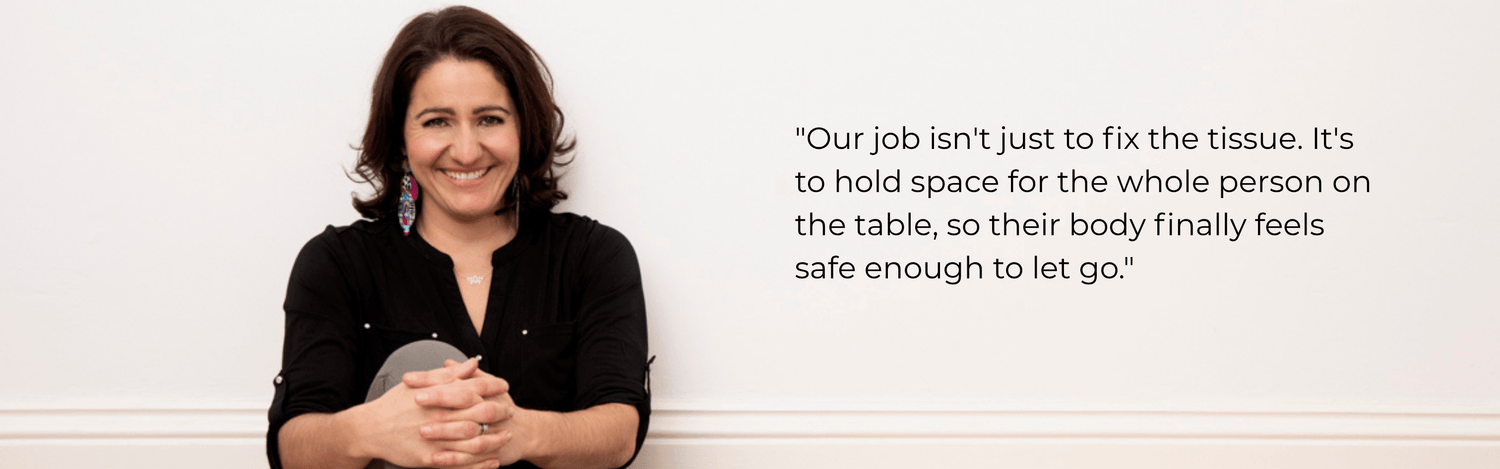
I've sat in both chairs
23 years as a massage therapist. Now a somatic psychotherapist and counsellor.
I'm Nikki Lucas, a PACFA-registered psychotherapist and counsellor with a Master's degree in Counselling and Psychotherapy.
Before moving into psychotherapy, I spent 23 years working as a remedial massage therapist. I understand the realities of hands-on practice — building trust with clients, working with persistent pain, and navigating those moments when something unexpected happens on the treatment table.
My training in psychotherapy, together with my work in somatic approaches to trauma, has deepened my understanding of how stress, trauma, and our sense of safety can influence the way we experience our bodies.
I've come to appreciate just how valuable this understanding can be for practitioners who work with people through touch.
I also understand that massage therapists and bodyworkers aren't psychotherapists, and shouldn't be expected to take on that role.
That's why I created this course.
I wanted to bring these two worlds together and give hands-on practitioners practical, relevant education to help them recognise signs of distress, respond thoughtfully, maintain professional boundaries, and work within their scope.
It's the kind of training I wish I'd had during my years as a massage therapist.
" I recently studied Trauma Informed Massage with Nikki and had such a positive experience.
I find Nikki to be experienced, professional, warm, confident and articulate.
I would encourage other practitioners to take the opportunity to learn from Nikki.
Sally, Adelaide Remedial Therapist
LET'S BE CLEAR
Who the course is for
It may be a good fit if you:
Work as a massage therapist, bodyworker or allied hands-on practitioner.
Want to understand how trauma and stress may influence a client's experience of treatment.
Have encountered emotional reactions or difficult situations in your work and want more guidance.
Want practical ways to support safety, choice and communication.
Want to maintain clear boundaries without losing warmth or compassion.
Are interested in supporting your own wellbeing as well as your clients'.
What this course isn't
This course is not training in psychotherapy, trauma processing or psychological diagnosis.
It doesn't teach you to conduct deep emotional regression work, treat trauma-related mental health conditions or replace your existing professional qualifications.
It doesn't promise that every client's pain or physical symptoms will resolve through trauma-informed care.
Instead, it focuses on helping you understand trauma-informed principles, recognise possible signs of distress, respond thoughtfully and know when to seek further support or refer.
The intention is to strengthen your existing practice, not take you outside it.
INSIDE THE COURSE
Four Modules. Real clinic skills.
MODULE 1
Realisation
Understand why trauma awareness matters in hands-on care.
Before you can respond differently, you need to understand what trauma-informed care means and why it matters.
In this module, you'll explore:
What trauma-informed practice is — and what it isn't.
How trauma and prolonged stress can influence a person's experience of their body, safety and touch.
The relationship between stress, the nervous system and physical wellbeing.
Why a person's responses may not always make sense from a purely physical perspective.
What this means for your practice: You'll have a clearer framework for understanding the person in front of you, rather than viewing every response through a purely physical lens.
MODULE 2
Recognise
Learn to notice signs that a client may be becoming overwhelmed.
Trauma responses don't always look the way we expect. A person may become visibly distressed, but they may also grow quiet, appear disconnected or show changes in their breathing, movement or engagement.
In this module, you'll explore:
How to recognise possible signs of nervous system activation.
Physical, emotional and behavioural responses you may notice in a treatment setting.
The window of tolerance and what it can help you understand.
How prolonged stress may interact with pain, tension and posture.
What this means for your practice: You'll have more information to help you notice when a client may need a pause, a change of approach or a conversation about what feels comfortable.
These signs are not a way to diagnose trauma. They are cues to slow down, stay curious and check in with the client.
MODULE 3
Respond
Know how to approach difficult moments with greater care and confidence.
Recognising that something has changed is one thing. Knowing how to respond is another.
This module focuses on practical strategies you can adapt to your own treatment setting.
You'll explore:
Why regulating your own response matters when a client becomes distressed.
Simple grounding and orienting strategies.
Ways to support a client's sense of choice and control.
How to communicate calmly and avoid making assumptions about what a client needs.
Practical verbal cues and frameworks to guide your response.
What this means for your practice: You'll have practical options to draw on when a client becomes distressed or overwhelmed, rather than feeling you need to improvise everything in the moment.
MODULE 1
Resist re-traumatisation
Protect client safety, maintain boundaries and work within your scope.
Trauma-informed care isn't only about what you do during a difficult moment. It's also about the conditions you create around your work.
In this module, you'll explore:
The importance of safety, choice, collaboration and consent.
How to maintain clear professional boundaries.
Recognising when a client's needs may fall outside your scope of practice.
When and how to consider referral to an appropriate professional.
Strategies to support your own wellbeing and reduce the risk of carrying your clients' stress home.
What this means for your practice: You'll have a clearer understanding of your professional role, the limits of that role and how to care for yourself while caring for others.
Less than one or two client sessions
One client retained, one tricky reaction handled with confidence. This course pays for itself in no time.
$197
$97
SAVE $100 AT LAUNCH PRICE - $AU
Full 4 Module Curriculum - Realise, Recognise, Respond, Resist
12 months access to all course materials
Practical frameworks and verbal cues, ready for your next session

QUESTIONS
Before you scroll off
Not at all. This course is written specifically for bodyworkers. It gives you the exact language and awareness you need for the clinic without expecting you to be a mental health clinician.
No. This course focuses entirely on trauma awareness, nervous system regulation, communication, and boundaries. It enhances the physical modalities you already practice.
Immediately. The principles, verbal cues, and grounding tools are designed to be woven into your next session.
A huge focus of this curriculum is teaching you how to stop burning out by anchoring your own system, which will ensure your career is physically and energetically sustainable.

Your clients already trust you with their body.
Give yourself the tools to hold what comes with it.
Trauma-Informed Care for Bodyworkers